

From #AuburnFast to #AuburnFaster
Past Auburn coaches have talked about playing with tempo. But Alex Golesh does it at a whole 'nother level — and has the numbers to back it up.
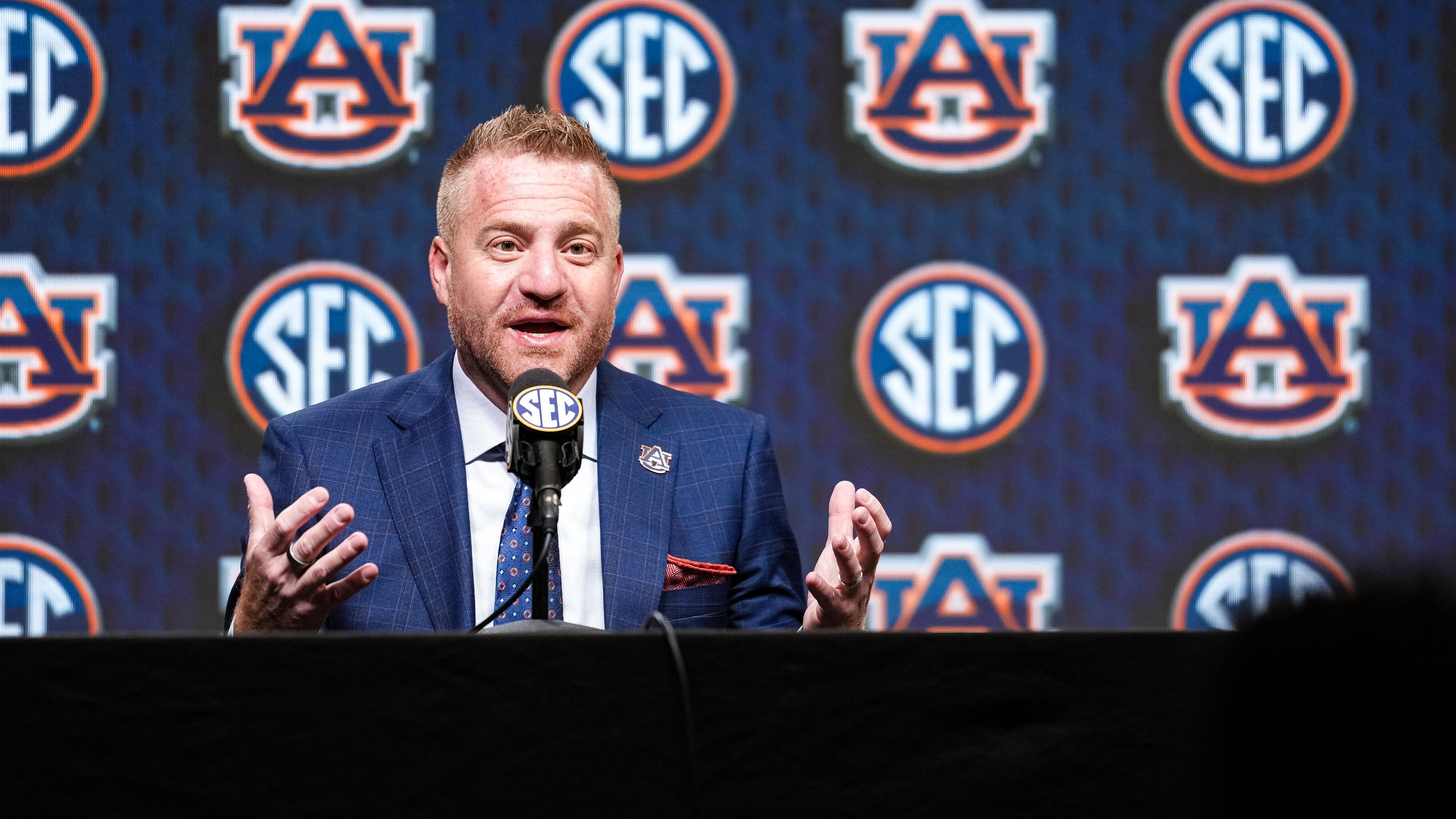
TAMPA, Fla. — Ever since he arrived at Auburn last December, the word around Alex Golesh is that he really sticks to his schedule.
In his time as Auburn’s new head football coach, Golesh has been all about accomplishing tasks as efficiently as possible, then moving quickly onto the next one.
This was on display Tuesday at SEC Media Days in Tampa, where he reignited a struggling USF program and earned a chance to return to the league as a head coach. Golesh was all over the hallways and side rooms of the Marriott on Water Street, ripping through interview after interview of a packed-out plan of attack.
No wonder his offenses operate that way, too.
Perhaps the most defining characteristic of Golesh to anyone in attendance at SEC Media Days this week is his preferred brand of offensive tempo.
Even if you aren’t plugged into all things Auburn or know the ins and outs of what he did at USF, you probably still know he goes fast — which started in this conference during his time at Tennessee as the offensive coordinator for Josh Heupel.
So, it should come as no surprise that this turned into a real topic Tuesday, when Golesh was speeding along during his time in the main Media Days room.
A media member pointed out to Golesh that his Auburn team was called the second-fastest offense in the country for the 2026 season by Pro Football Focus:
Auburn operated at only a slightly above-average tempo last season, but that figures to change drastically in 2026. That’s because the Tigers hired Alex Golesh away from USF, and he arrives with his highly regarded quarterback Byrum Brown via the transfer portal.
The pair directed a blistering veer-and-shoot offense in Tampa that helped USF reach nine wins for the first time in eight years. A major part of that success came from refusing to let opponents catch their breath. The Bulls operated at tempo on 48.2% of their offensive plays, 6% higher than any other team in the country.
This marks the fourth straight season that Golesh’s offense has led the nation in tempo play rate. That includes his three years at USF along with the season before it, where he topped the charts as Tennessee’s offensive coordinator while working under Josh Heupel.
Golesh’s offenses have only become more aggressive with each passing season. Last year’s Bulls are the only team to come close to playing at tempo on half of their offensive snaps since PFF began tracking such data. An increase in competition level and new surroundings may force Golesh to ease off the accelerator slightly, but having a quarterback already fluent in the system should make the transition much smoother.
PFF’s tempo numbers are a little more advanced than the standard ones, as they base their findings off of detailed film review. And, like the excerpt above states, the database has only been tracking that statistic for a limited amount of time.
But one of the oldest and easiest methods of finding out how fast an offense likes to operate is by looking at the average amount of seconds of possession it has per play.
In that category, Golesh and new Auburn offensive coordinator Joel Gordon — along with quarterback Byrum Brown and so many other pieces to the Tigers’ attack now — engineered the No. 2 fastest pace in the country last season, just behind rival FAU.
The year before that, USF was… No. 2, only behind conference foe North Texas. The year before that, USF was… No. 2, joining Jacksonville State as the only teams in FBS that averaged less than 21 seconds per play. (Former JSU head coach Rich Rodriguez, now back at West Virginia, has PFF’s No. 1 fastest offense for 2026.)
During his two seasons at Tennessee with Heupel, Golesh’s offenses ranked No. 1 and No. 2, respectively, in average seconds per play. No other coach in the country has been consistently in the top five as much as Golesh, much less the top two.
“I think offensive football is about finding matchups in space, and we chose to do it really, really quickly,” Golesh said Tuesday.