

Auburn's best bet on offense? Let Tahaad Pettiford run wild.
This year, the numbers show something clear: Get the Tigers' point guard playing with pace — and good things will happen more often than not.
This morning’s edition of The Observer comes courtesy of basketball contributor Henry Patton. A few days ago, Henry sent me (Ferg) some notes on what he had been seeing recently from Tahaad Pettiford — and that turned into this breakdown of the sophomore point guard at a crucial time for the Tigers.
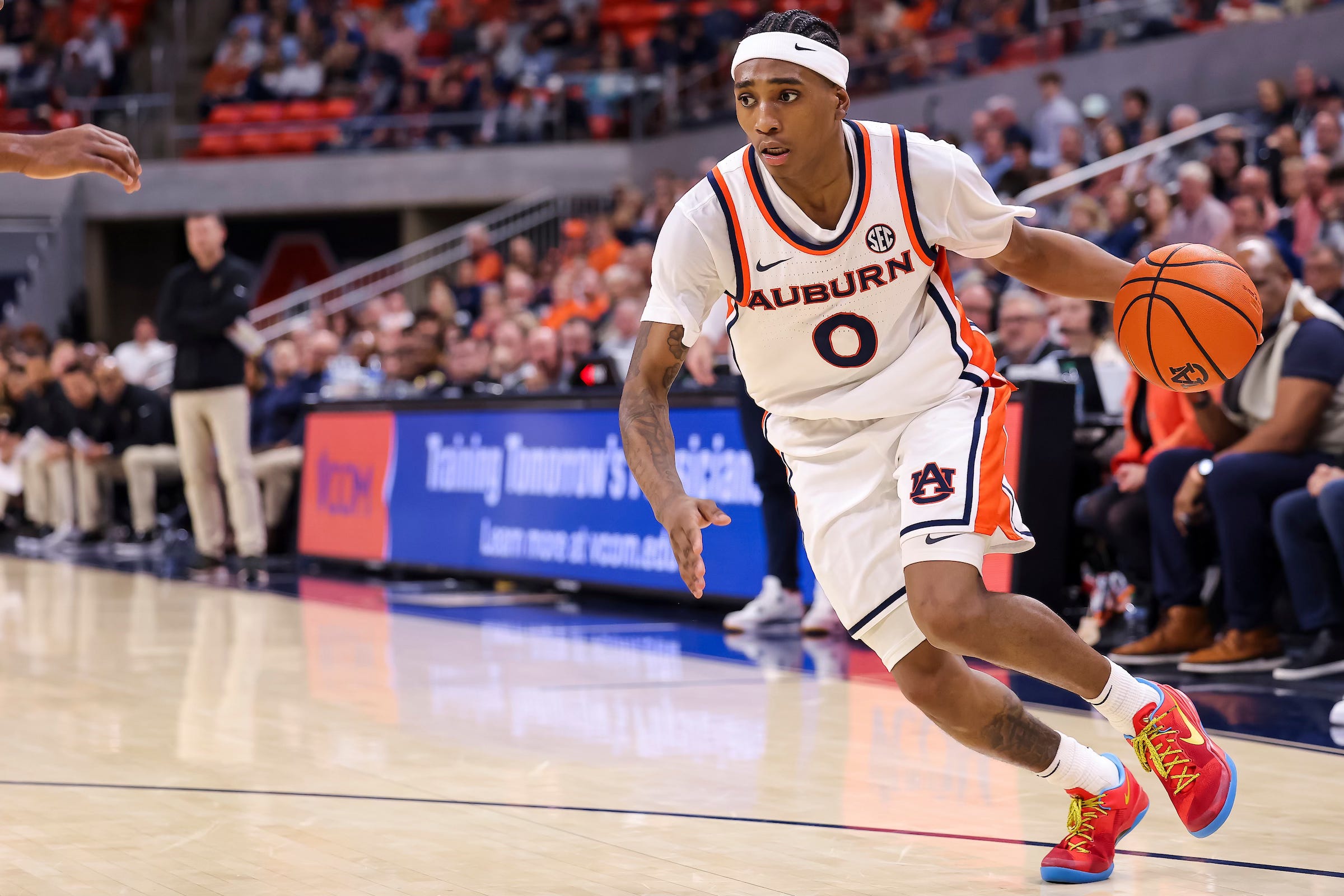
It’s been an up-and-down season for Tahaad Pettiford.
In some games, he’s shown the brilliance that was expected of him after he burst onto the scene as a freshman. In others, he has played shockingly poor.
Now, some of his struggles can be attributed to him going from his spark plug, electric scorer off the bench role that he played last season to now being the top name on the scouting report.
One thing that has not faded is Pettiford’s ability to play his best against the stiffest competition on Auburn’s loaded schedule.
Pettiford has scored 25 or more points four different times this season: St. John’s, Arizona, Georgia and Alabama — all of which are ranked inside the top 40 on KenPom.
Those four teams also have something else in common: they’re all ranked inside the top 75 in adjusted tempo, which essentially lists teams from the most average possessions in a game to the fewest.
When this Auburn roster was built, the vision seemed like this was going to be a team that played fast, and Pettiford was going to be the engine behind that.
That hasn’t totally been the case. Auburn ranks No. 194 in adjusted tempo, which is slightly below average nationally.
There are multiple reasons why this has been the case, with the main being that Keyshawn Hall, Auburn’s leading scorer, is at his best creating in isolation in the half-court. But this has meant that Pettiford has, at times, been relegated to a spot-up role similar to the one he played last year.
Yet this is an entirely new roster. See, last year, it made sense for Pettiford to play off of guys like Johni Broome, Denver Jones and Chad Baker-Mazara, among others. But outside of Hall — who isn’t known for being an elite passer — Auburn doesn’t have any other offensive threats nearly as strong as the aforementioned three. This means that Pettiford’s role, when Auburn has been forced to play slower, has been clunky.
However, when Auburn has been forced to play at a higher pace, Pettiford has looked more like what we expected from him coming into the season.
And that could be important for the Tigers down the stretch, as they look to end their recent losing skid and hit March with momentum.
Using that same KenPom tempo rating, Auburn has played 10 teams with a pace faster than its own and six slower. Here are Pettiford’s stats in those games:
vs. teams slower than Auburn:
10.7 points, 2.3 rebounds, 2.8 assists and 1.2 turnovers per game on 30/21/88 shooting splits and 42% true shooting
11.5 shot attempts (6.3 from 3) and 2.7 free throw attempts per game, with a 22.2 usage rate
vs. teams faster than Auburn:
17.8 points, 3.2 rebounds, 3 assists and 2.5 turnovers per game on 44/32/85 shooting splits and 57% true shooting
13.8 shot attempts (6.5 from 3) and 4.1 free throw attempts per game, with a 27.1 usage rate
This is an absolute night and day difference across the board for Pettiford.
But why is this the case?