

Film Room: How Auburn chomped down on defense to beat Florida
In order to get a historic road win, the Tigers had to design — and execute — a brilliant defensive game plan. Let's dive into why it worked.
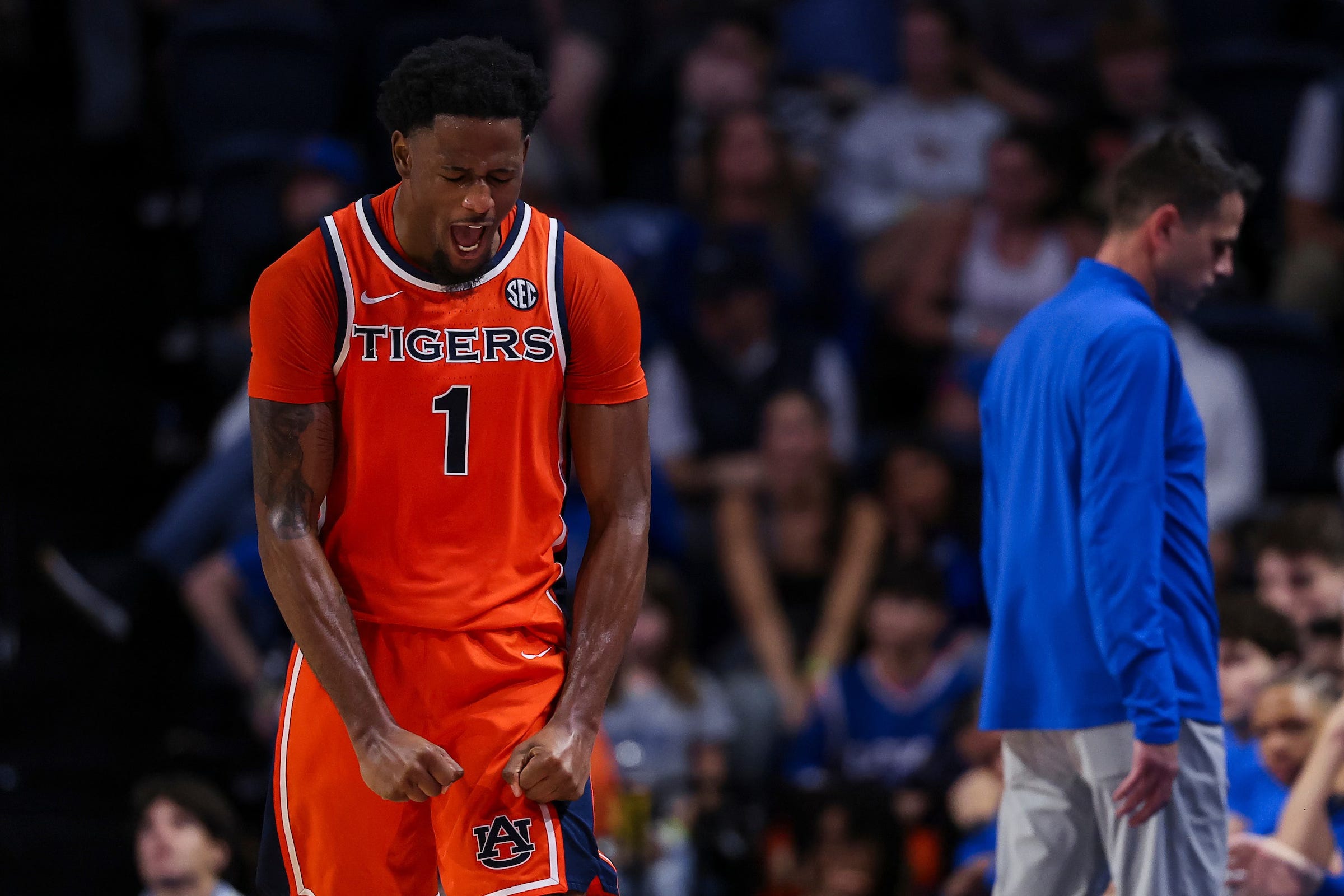
AUBURN — The challenge was as daunting as any Auburn would face the rest of the way.
Never mind that Auburn had not won a men’s basketball game at Florida in 30 years. This was the best version of the Gators the Tigers had encountered in Gainesville since Billy Donovan was rolling out back-to-back national champions there.
And these Gators were defending national champions who had rediscovered their elite form. Todd Golden’s Gators had won five straight and were overwhelming opponents at home. In its nine games inside the O’Dome, Florida had scored at least 80 points seven times — and at least 90 five times, including twice in SEC play.
Florida ranked top 20 nationally in shots attempted per game and 2-pointers made per game. The Gators owned a top-30 scoring offense and a top-15 unit in KenPom’s opponent-adjusted offensive efficiency. This was a titanic opponent, powered by one of college basketball’s best, biggest and most experienced frontcourts.
Auburn understood the challenge in front of them.
Elite teams with comparable size and scoring profiles — Michigan, Arizona and Purdue — had all dominated the Tigers in non-conference play, beating Auburn by a combined 87 points. Auburn had not come close to being competitive in these types of matchups away from Neville Arena, surrendering 95.7 points per game in those three losses.
Even as Auburn began to turn a corner defensively with stronger performances in SEC wins over Arkansas, South Carolina, and Ole Miss, Florida was different.
Then, for a majority of the 40 minutes Saturday in Gainesville, Auburn took it to Florida and won with its defense. The Tigers held Florida to just 67 points, one of the Gators’ lowest home outputs in several seasons.
So how did this happen?
How did a team that had spent most of the season playing inconsistent-at-best defense perform at such a high level on the road?
How did these Tigers — the ones who lacked their usual rim protection from years past — neutralize one of the biggest frontcourts in the country?
To answer those questions, it’s time to head back to the Film Room.
In this edition, we’ll break down more than a dozen possessions from Auburn’s historic road win over Florida — sequences that illustrate just how effective the Tigers were at executing the defensive game plan set by Steven Pearl and his staff.
And, since excellent team defense requires a lot of action from all five guys on the floor at the same time, we’ve slowed down the playback speed of these game clips — so you can get a better look at all the pieces working together to generate stop after stop.
Auburn’s defensive keys vs. Florida:
Pack the paint
Communicate
Switch and rotate
Push out the post-ups
Shade, dig, and double
Swipe in traffic
Shorten closeouts — “toes to the line” — against a team that struggles from deep
What You’re Willing to Allow
Florida technically strikes first.
Thomas Haugh opens the game by knocking down a corner 3 — for what would be Florida’s only lead of the afternoon — but the possession reveals exactly what Auburn wants to accomplish defensively.
The Gators set up in their go-to Horns formation with the bigs at the elbows and the wings deep in the corners. As the play begins with an Over action, Boogie Fland enters the Ball to Alex Condon on the left elbow and dive cuts to the basket. Hands go high as Kevin Overton chases him to the paint. On the weak side, KeShawn Murphy steps all the way to the front of the rim to prevent the give-and-go bucket.
Condon DHOs (dribble hand-off) to Haugh and here is where Auburn commits to one of its keys: Sebastian Williams-Adams and Keyshawn Hall switch on the left wing.
As Haugh feeds the ball into the post for Condon, SWA digs down from the wing. He flashes, effectively showing a soft double, but never turns his body so that he can recover quickly back out to Haugh as the ball is kicked back out. That sequence — dig on the catch and recover — becomes a recurring theme throughout the game.
The objective is straightforward: make Florida’s bigs work, deny clean post touches, and force the offense to operate around the perimeter. With a massive frontcourt and a guard group that hasn’t shot the ball consistently from deep, Auburn is comfortable trading post efficiency for outside attempts.
Haugh re-enters the ball to Condon, and SWA continues to stunt. This time, Condon puts the ball on the floor, initiating a more committed double-team effort from SWA, while Haugh makes a basket cut out of SWA’s sight. Murphy recognizes it immediately, though, and steps back into the paint to check another cutter without fully abandoning his matchup, Rueben Chinyelu.
Haugh exits to the opposite corner, where Condon finds him on the kick-out. Williams-Adams recovers quickly, taking away the catch-and-shoot look and forcing Florida to continue the possession.
When Florida flows into a Condon ball screen for Fland at the top of the key, Hall and Overton switch and SWA steps in to account for Condon’s roll and Fland’s drive — once again prioritizing the interior help over staying glued in the corner.
Fland drives, draws help, and kicks the ball back out to Haugh. With SWA pulled inside, Haugh finally has space — and this time, he catches and hits the corner 3.
It’s a successful possession for Florida, but not one Auburn is unhappy with. Pearl, typically quick to show displeasure on defensive breakdowns, simply claps and nods.
The Tigers forced Florida deep into the shot clock, disrupted multiple actions, and dictated where the shot came from. Haugh may not be the exact shooter Auburn wants taking that look, but long, late-clock perimeter attempts are a trade the Tigers will accept from this Florida offense more often than not.
Help from the Bottom, Dig from the Top — The First Stop